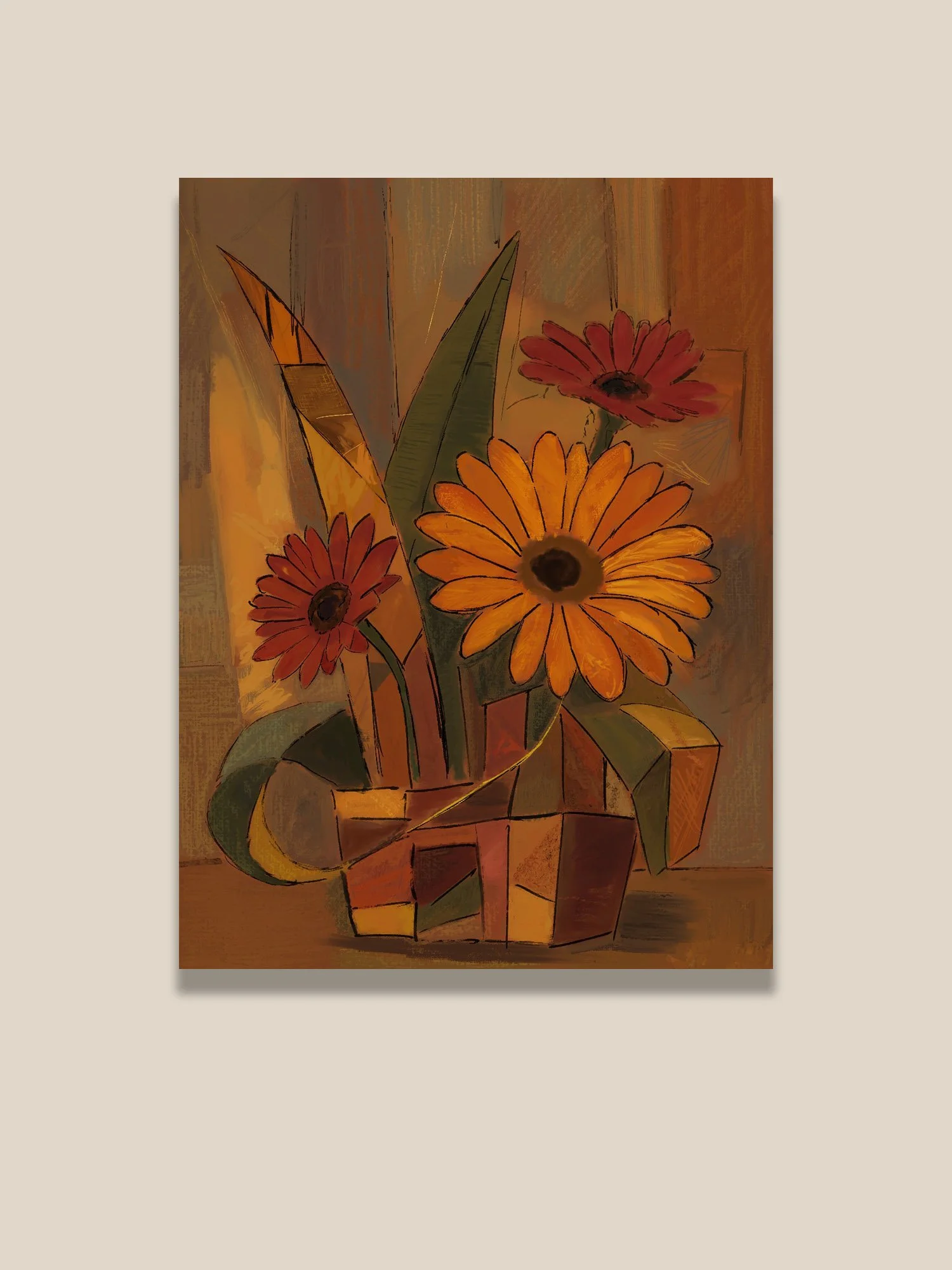
What is Contemporary Cubism?
Contemporary Cubism continues to evolve far beyond its early twentieth-century origins. This article explores how modern artists use fragmentation, layered perspectives, and symbolic abstraction to address themes of technology, memory, identity, surveillance, and contemporary life.
Cubism is often associated with artists like Pablo Picasso and Georges Braque, who helped develop the movement in the early twentieth century. Characterized by fragmented forms, multiple perspectives, flattened space, and geometric abstraction, Cubism challenged traditional ways of representing reality and fundamentally changed the direction of modern art.
More than a century later, Cubism continues to influence contemporary artists across painting, sculpture, graphic design, architecture, and digital media. Rather than existing as a historical style frozen in time, contemporary Cubism has evolved into a flexible visual language capable of addressing modern experiences, anxieties, and systems of perception.
The Origins of Cubism
Traditional Western painting often attempted to create the illusion of stable space and realistic perspective. Early Cubist artists disrupted this approach by presenting subjects from multiple viewpoints simultaneously. Objects, figures, and environments were broken apart and reconstructed into layered geometric forms that encouraged viewers to actively interpret the image rather than passively observe it.
Cubism emerged during a period of rapid industrialization, technological change, and cultural transformation. Photography, urbanization, machinery, and new scientific theories all contributed to changing understandings of time, space, and perception. Cubism reflected this instability by abandoning singular viewpoints in favor of fractured and shifting perspectives.
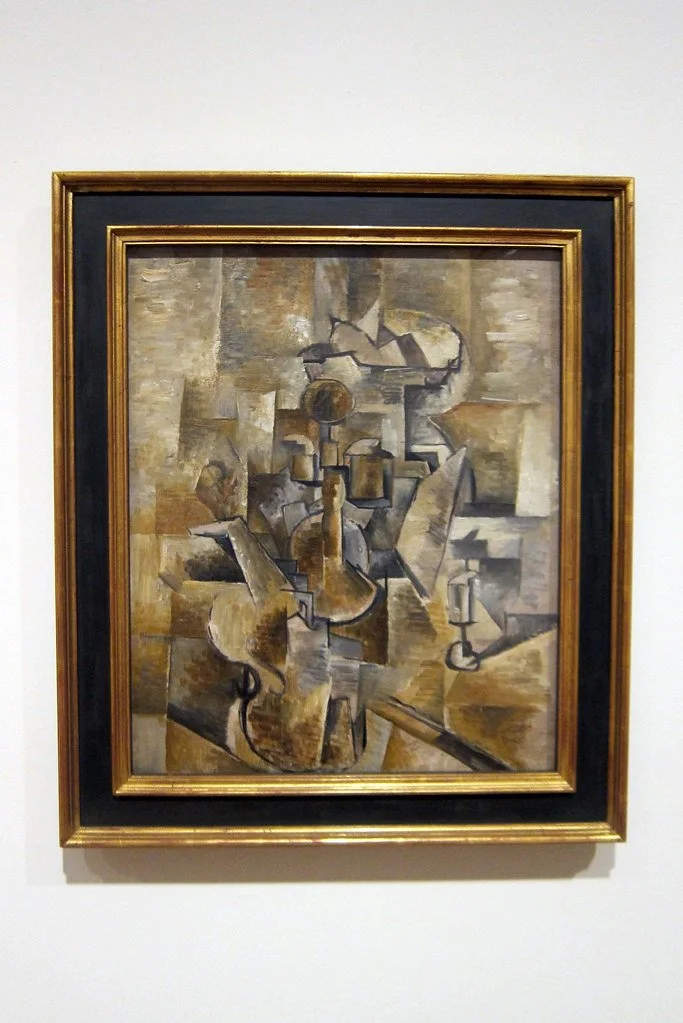
Violin and Candlestick is an early Cubist still life painting composed of fragmented geometric planes and overlapping perspectives. The composition depicts a violin, candlestick, and surrounding tabletop elements broken apart into angular shapes rendered in muted browns, ochres, and grays. Rather than presenting the objects from a single fixed viewpoint, Georges Braque reconstructs them through shifting perspectives and layered spatial relationships, creating a flattened and abstracted interpretation of form characteristic of early Analytical Cubism.
What Makes Contemporary Cubism Different?
While contemporary Cubism draws from the formal innovations of early Cubism, many contemporary artists use fragmentation and abstraction to explore themes that extend beyond formal experimentation alone.
Contemporary Cubist painting often addresses:
identity
technology
surveillance
memory
labor
displacement
environmental anxiety
psychological fragmentation
digital culture
Rather than simply imitating historical Cubist aesthetics, contemporary artists adapt Cubist structures to reflect the complexities of modern life. Fragmentation becomes more than a visual device—it becomes a metaphor for how contemporary individuals experience information, identity, and reality itself.
Fragmentation and Modern Experience
Today, people encounter the world through overlapping systems of media, technology, advertising, social platforms, surveillance, and rapid information exchange. Experiences are often fragmented, nonlinear, and psychologically layered. Contemporary Cubism mirrors these conditions visually.
Multiple perspectives within a single composition can suggest:
conflicting viewpoints
unstable memory
emotional tension
fractured identity
technological mediation
simultaneous realities
This makes Cubism particularly relevant in contemporary society, where perception is increasingly shaped by screens, algorithms, and digital environments.
Contemporary Cubism in Farron Khan’s Work
Colorado artist and contemporary painter Farron Khan incorporates Cubist fragmentation, layered symbolism, and shifting spatial relationships throughout his oil paintings and printmaking work. Influenced by both historical Cubism and contemporary social realities, his paintings explore themes of labor, memory, surveillance, technology, identity, and psychological atmosphere.
Works such as Voyager, Drone Warfare, The Gathering, and Don’t Look Back! You’re Not Going That Way! use fragmented forms and symbolic imagery to examine how individuals navigate uncertainty, systems of power, and collective experience. Rather than treating Cubism as a purely historical style, the work approaches it as an evolving visual language capable of addressing contemporary concerns.
In paintings like The Peach Farmer, Cubist structure becomes a way of emphasizing labor and human endurance, while works such as Eco Pill and Drone Warfare use fragmentation to reflect environmental anxiety and technological tension.
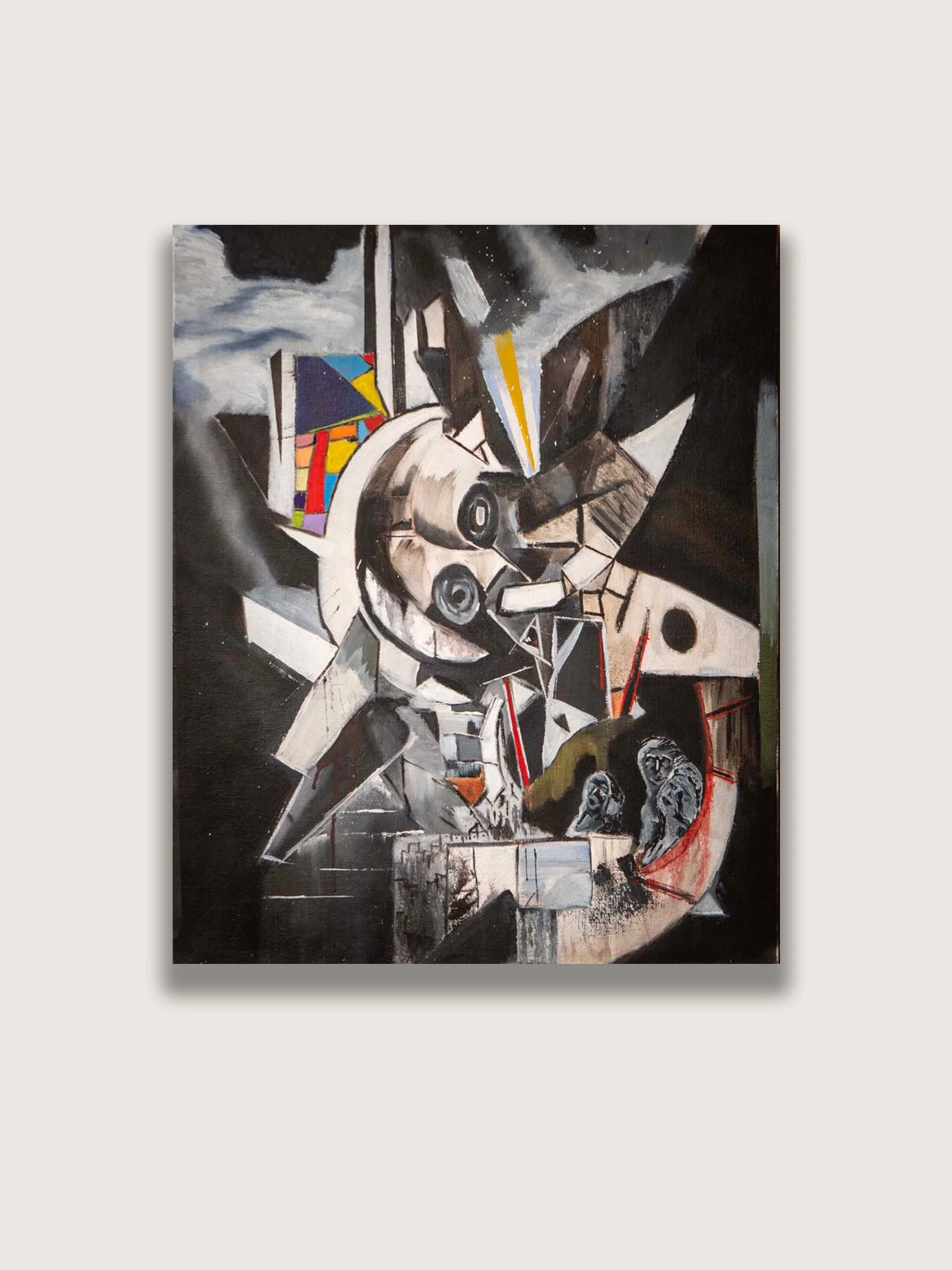
Drone Warfare is a contemporary Cubist oil painting by Farron Khan exploring surveillance, modern conflict, and the psychological distance created by military technology. Through fragmented forms, layered spatial planes, and symbolic mechanical imagery, the composition reflects the tension between human vulnerability and systems of technological control. Angular distortions and overlapping perspectives create an atmosphere of instability and unease, emphasizing themes of observation, power, and the emotional disconnection associated with remote warfare. Influenced in part by Khan’s military background and contemporary geopolitical realities, the painting examines how surveillance technologies increasingly shape both conflict and everyday life.
Why Contemporary Cubism Still Matters
Contemporary Cubism remains relevant because it reflects the instability and complexity of modern life. Its fractured visual structures mirror how people process memory, identity, information, and emotion in an increasingly interconnected world.
By presenting multiple perspectives simultaneously, Cubist-inspired art challenges viewers to slow down, interpret relationships between forms, and engage more actively with what they see. In doing so, contemporary Cubism continues the original movement’s ambition of expanding how reality itself can be represented through art.
Rather than belonging solely to art history, Cubism continues to evolve as artists reinterpret its visual language in response to contemporary culture, technology, and lived experience.
How Military Experience Influences My Cubist Paintings and Printmaking
In this post, Western Colorado artist Farron Khan discusses how military service, fragmentation, memory, and psychological landscapes influence his Cubist oil paintings and linocut printmaking.
Art rarely emerges in isolation. The experiences we move through, the environments that shape us, and the systems we exist within all leave traces behind. My work is deeply informed by growing up in Western Colorado, serving in the military, and navigating the psychological landscapes that remain long after specific events have passed.
Working primarily in oil painting and linocut printmaking, I use fragmentation, layered imagery, and symbolism to explore how memory, labor, place, and identity intersect. Much of this visual language stems from experiences that resist simple narratives or singular perspectives. Military life, in particular, altered the way I understand structure, perception, and the relationship between individuals and larger systems.
Rather than attempting to document experiences literally, my paintings and prints examine the emotional and psychological residue left behind by them.
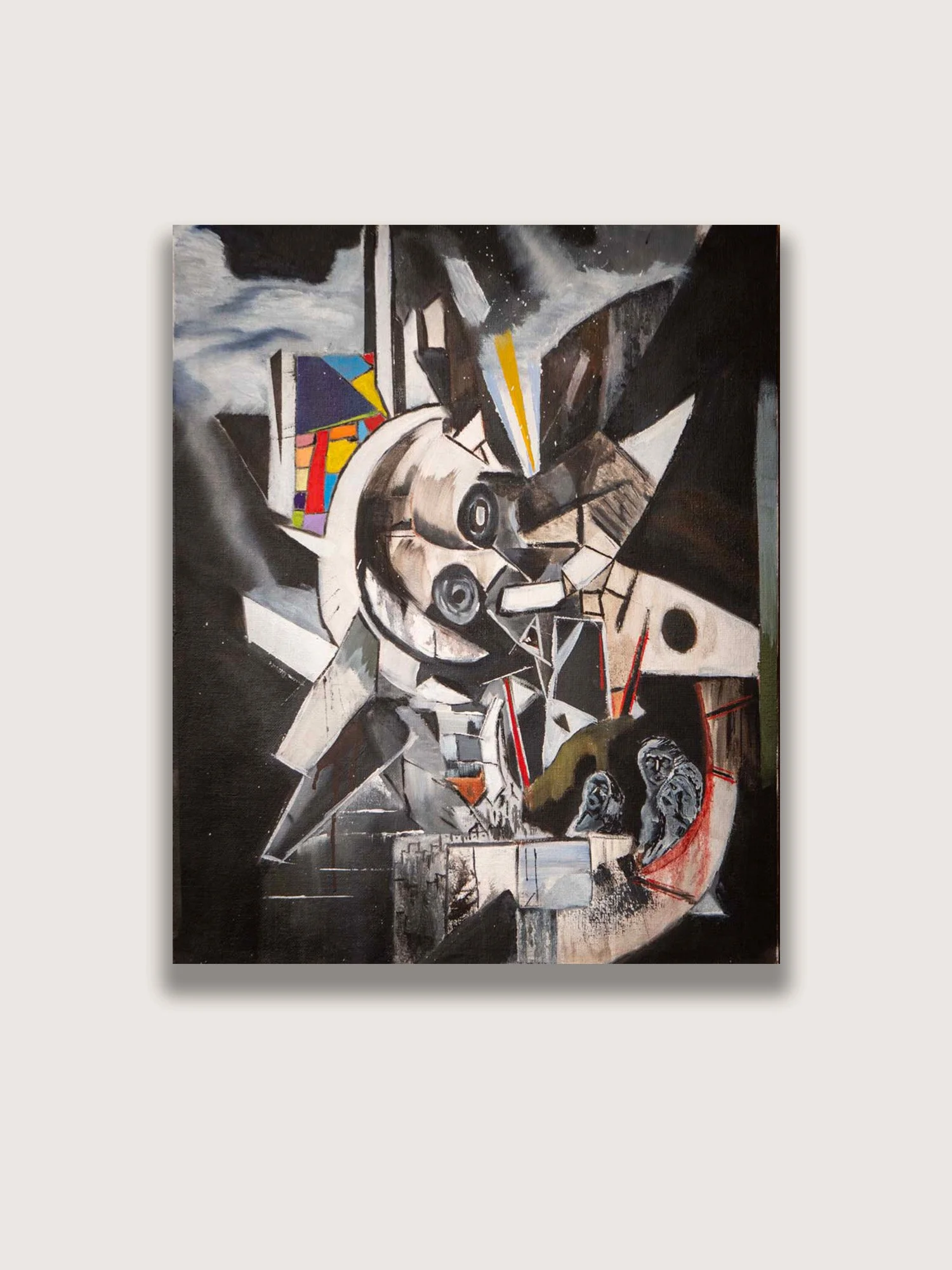
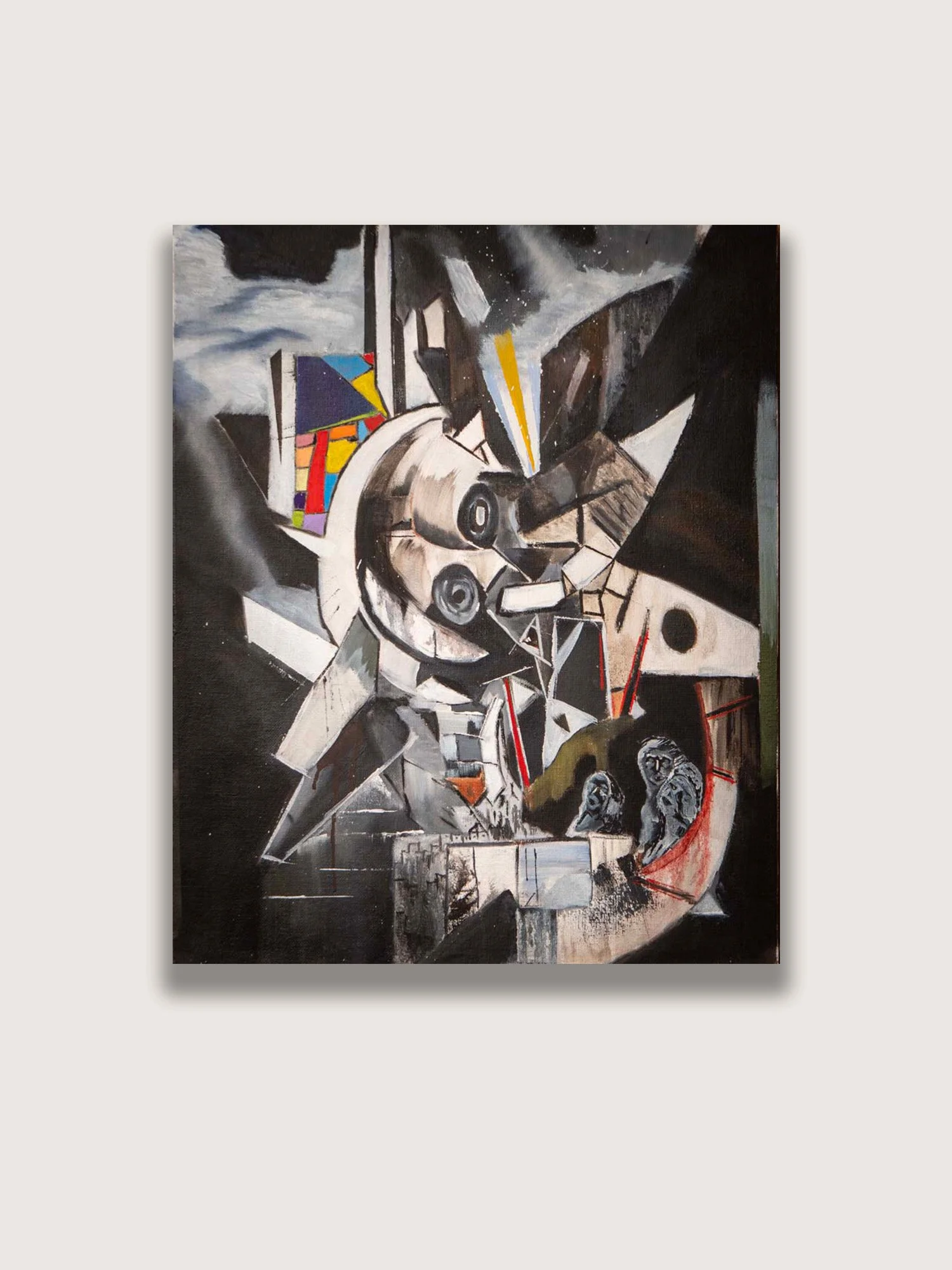
Drone Warfare uses fragmentation and layered Cubist imagery to explore the emotional distance, psychological fragmentation, and abstraction of violence within modern technologically mediated conflict.
Why Fragmentation Appears in My Artwork
Fragmentation became an important visual language in my work because memory itself rarely functions in a linear way. Experiences often return in fragments: images, sensations, environments, or emotions disconnected from a complete narrative. Cubism and related forms of distortion allow me to visually represent that instability while also acknowledging that multiple perspectives can exist simultaneously.
In many of my paintings, figures, spaces, and objects overlap or break apart into shifting planes. This process is not simply stylistic. It reflects the tension between personal memory, collective history, and the ways people construct meaning from incomplete information.
Military environments often emphasize systems, repetition, hierarchy, and collective identity. At the same time, individual experiences within those systems can vary dramatically. Fragmentation allows me to address those contradictions visually rather than resolving them into a single fixed interpretation.
I am interested in how people carry experiences long after they leave particular environments, and how those experiences continue shaping perception over time.
Landscape as Psychological Space
Growing up in Western Colorado also plays an important role in my work. Landscapes are never neutral to me. Places accumulate emotional weight through memory and association. A hometown can feel comforting while simultaneously holding tension, contradiction, or unresolved history.
Similarly, military spaces often become psychologically charged environments. Barracks, training grounds, deserts, industrial structures, and temporary architecture all carry a particular emotional atmosphere. Even after leaving those places, aspects of them remain embedded in memory.
My paintings frequently blur distinctions between interior and exterior spaces, physical environments and psychological states. I am less interested in creating direct representations of locations than I am in exploring how environments shape emotional experience.
Labor, Systems, and Overlooked People
Another recurring focus in my work is labor and the people whose work quietly sustains daily life. I am drawn to individuals and communities that are frequently overlooked despite playing essential roles within larger systems.
Military life reinforced my awareness of institutional structures and the ways individuals are often absorbed into broader mechanisms of organization, production, and power. That awareness extends beyond military experience and informs how I think about labor, technology, infrastructure, and social systems more broadly.
Many of my paintings and prints examine how people navigate these systems while attempting to preserve individuality, dignity, and meaning. Through layering, distortion, and repetition, I try to create images that feel simultaneously human and structural.
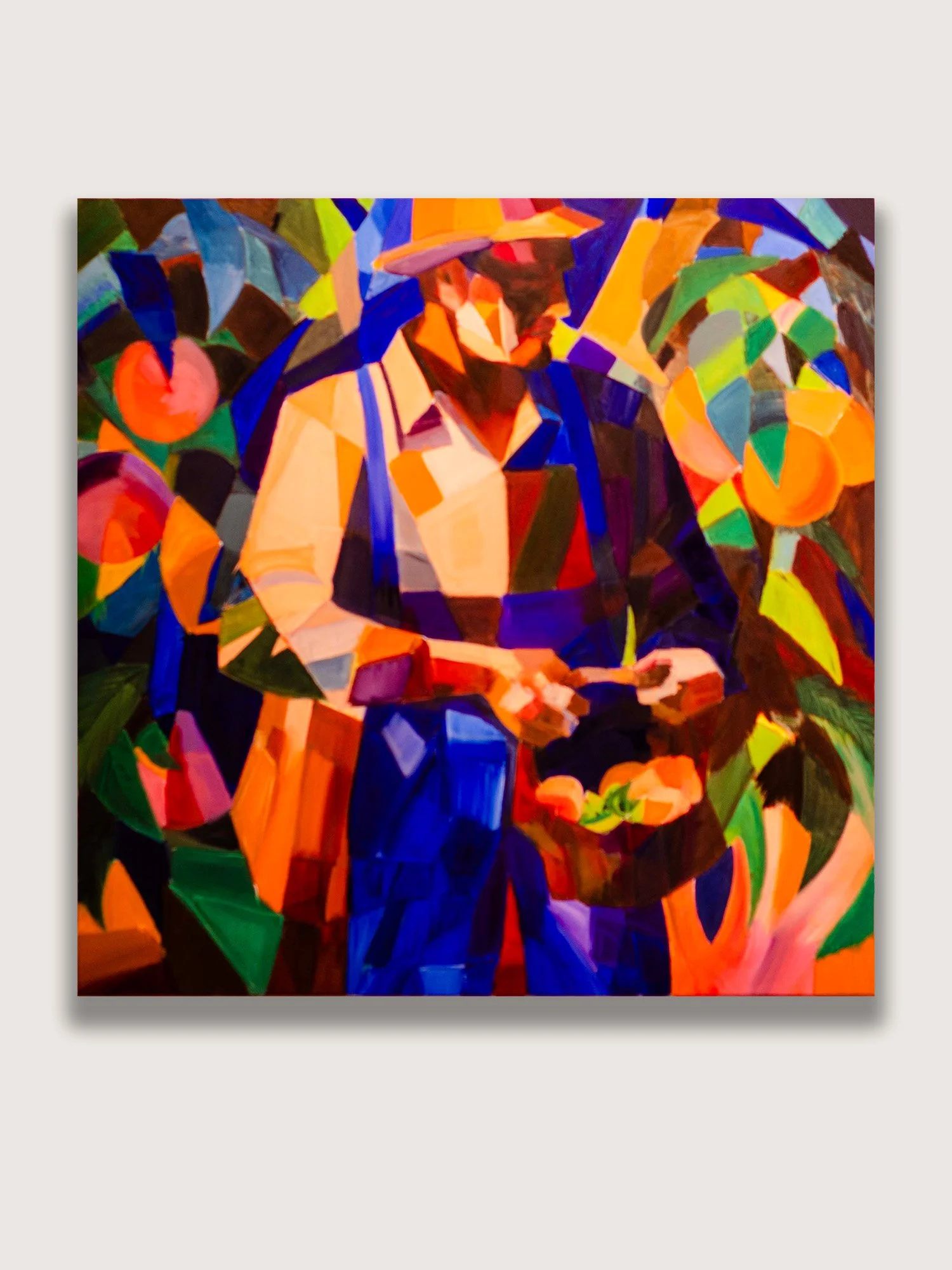
Peach Farmer uses Cubist fragmentation and layered perspectives to explore labor, identity, and the enduring relationship between agricultural workers and the landscapes that shape their lives in Western Colorado.
Why I Continue Working in Oil Painting and Printmaking
Oil painting and linocut printmaking both allow for a slow and deliberate process of construction. I am drawn to mediums that leave visible evidence of labor, revision, and accumulation over time.
Printmaking especially appeals to me because carving into a surface requires commitment and physical engagement. Every mark becomes part of the final image. Painting, meanwhile, allows for layering, revision, and the gradual building of relationships between color, texture, and form.
Both mediums support the themes I am interested in exploring: memory, endurance, fragmentation, and reconstruction.
Art as Reconstruction Rather Than Resolution
I do not view art as a way of simplifying experience into clear answers. Instead, I think of painting and printmaking as spaces where complexity can remain visible. Experiences related to memory, military service, place, and identity rarely resolve cleanly, and I am more interested in preserving ambiguity than forcing closure.
My work invites viewers to navigate layered images in much the same way people navigate memory itself: partially, emotionally, and from multiple perspectives at once.
Ultimately, the goal is not to recreate specific events, but to create visual spaces where viewers can reflect on labor, history, place, and the systems that quietly shape everyday life.
Farron Khan is a Western Colorado artist working in oil painting and linocut printmaking. His work explores fragmentation, labor, memory, and psychological landscapes.
Fragmentation, Memory, and Perspective in Contemporary Painting
This post explores how fragmentation functions within my Cubist-inspired painting practice as a way of addressing memory, layered perspectives, labor, and the complexity of contemporary experience.
Fragmentation has become one of the most important visual tools in my work because it allows me to move beyond a single fixed perspective. Rather than presenting an image as something stable, complete, or easily resolved, fragmentation gives me a way to explore the layered nature of memory, place, labor, technology, and personal experience. It reflects the reality that the subjects I paint are rarely simple or singular. They exist across multiple emotional, historical, and psychological dimensions at once.
My work is heavily influenced by Cubism, expressionist print traditions, and the visual language of layered imagery. I am interested in how a painting can hold several viewpoints simultaneously and how fragmented forms can create a sense of movement between those viewpoints. Instead of treating fragmentation as destruction or chaos, I approach it as a method of construction. By breaking apart forms and rebuilding them through overlapping planes, repeated shapes, and shifting perspectives, I can create compositions that feel more reflective of lived experience.
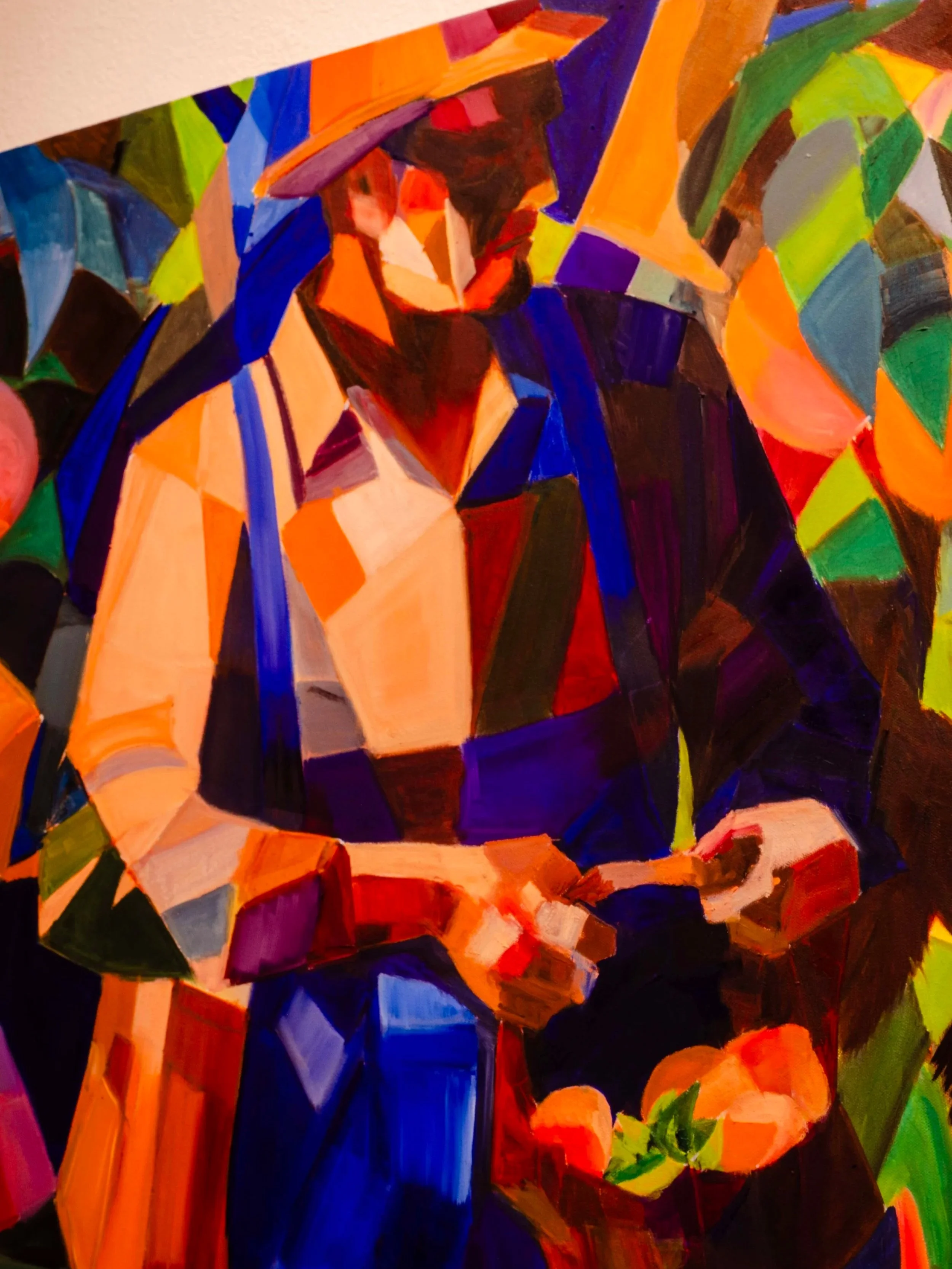
Fragmented geometric planes and saturated color transform an everyday agricultural scene into a layered meditation on labor and identity.
A single image often cannot fully communicate the complexity of a subject. When I paint landscapes, figures, or symbolic objects, I am usually thinking about more than what is immediately visible on the surface. I am thinking about memory, environment, labor, belief systems, technology, and the emotional weight attached to certain places and experiences. Fragmentation allows these ideas to exist together within the same composition.
In many ways, fragmentation mirrors the way memory itself operates. We rarely remember experiences as perfect, uninterrupted images. Instead, memories arrive in pieces — flashes of color, isolated objects, emotional impressions, fragments of conversations, or disconnected environments that become linked together over time. Through fragmentation, I try to recreate that sense of layered recollection. Different sections of a painting can function almost like separate memories or perspectives colliding within the same visual space.
This approach is also important because it helps me address the many sides of the subject matter I am exploring. Many of the themes in my work involve contradiction or tension. A landscape can represent both beauty and hardship. Technology can symbolize both connection and surveillance. Labor can communicate resilience while also pointing toward exhaustion and invisibility. Fragmentation gives me a way to hold those competing ideas together rather than forcing the image into a single interpretation.
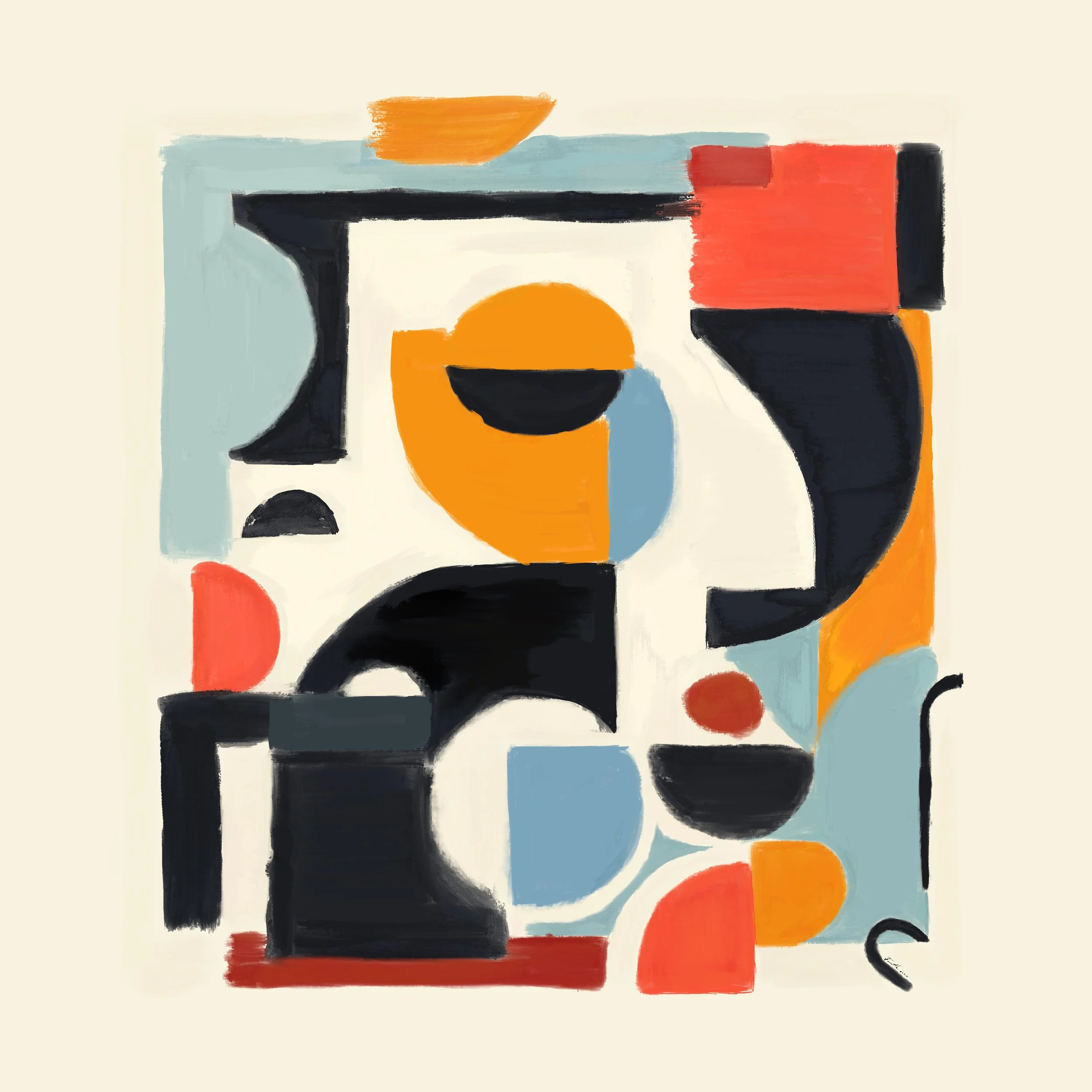
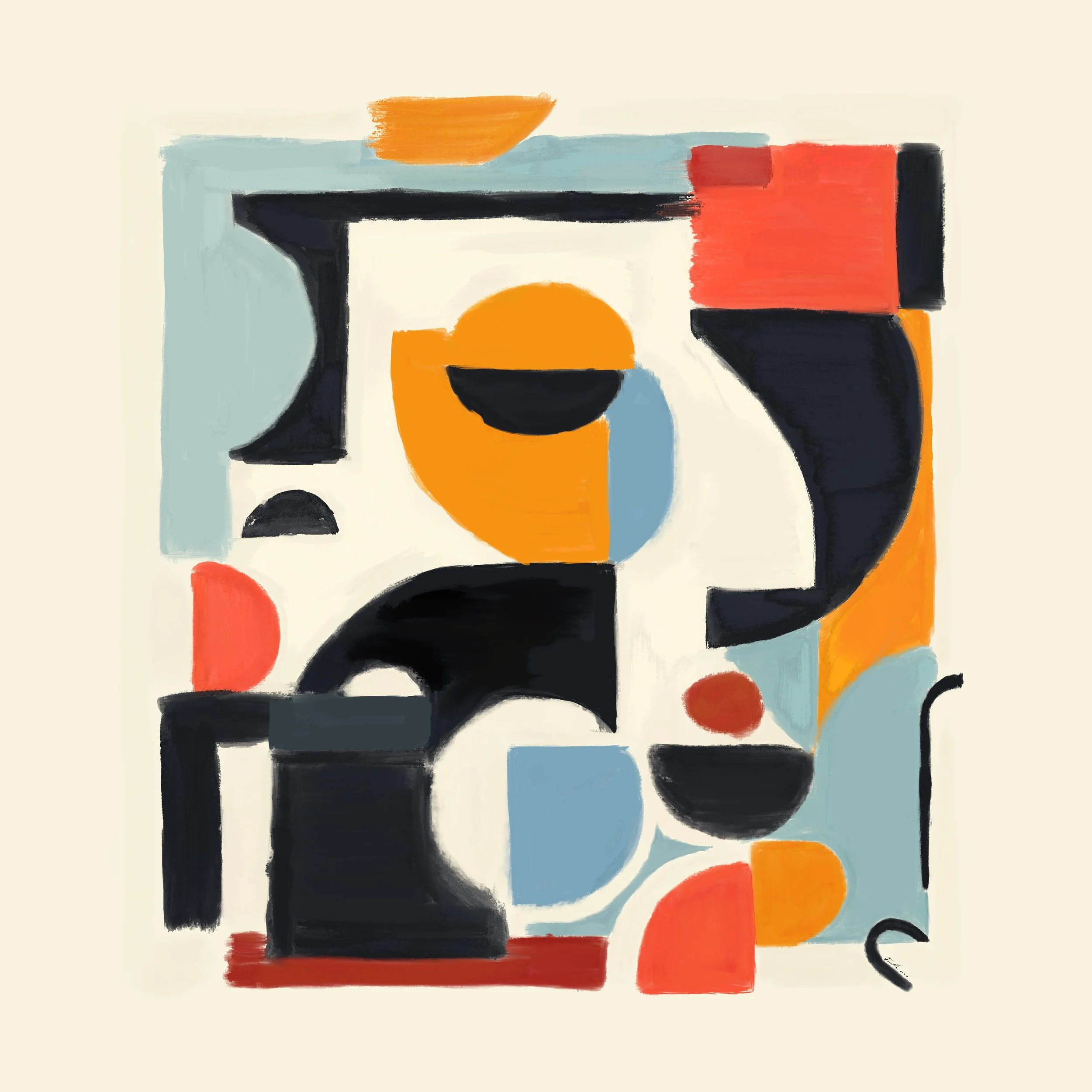
Modular Portrait explores fragmentation through simplified geometric forms and layered spatial relationships. Repeating shapes, cropped curves, and contrasting color fields create a shifting sense of structure, suggesting multiple perspectives existing simultaneously within a unified composition.
I think this is one of the reasons I continue returning to Cubist structures within my paintings and prints. Cubism challenged the idea that an artwork needed to present one stable perspective. Instead, it opened up the possibility that multiple viewpoints could exist simultaneously. That idea still feels incredibly relevant to contemporary life. We constantly experience overlapping realities through memory, media, history, and personal experience. Fragmentation becomes a way of visually acknowledging that complexity.
The physical process of painting fragmented forms is also important to me. Building a composition through layered shapes, directional lines, and shifting planes creates a kind of visual rhythm that guides the viewer across the surface of the painting. I often use changes in color temperature, edge quality, and repetition to create movement between forms. Even when the imagery becomes abstracted, I want the viewer to feel a sense of structure and intentionality beneath the surface.
At the same time, fragmentation allows space for ambiguity. I do not always want the viewer to arrive at a single fixed conclusion about a piece. Instead, I want the work to remain open enough for multiple readings and emotional responses. Fragmented imagery invites the viewer to participate in reconstructing the image and interpreting its meaning. In that sense, the viewer becomes part of the process.
Ultimately, fragmentation is not simply an aesthetic choice in my work. It is a way of thinking about perception, memory, and the complexity of contemporary experience. By breaking apart and reassembling forms, I am trying to create paintings that reflect the layered realities behind the subjects I explore — realities that cannot always be communicated through a single perspective alone.