What is Contemporary Cubism?
Cubism is often associated with artists like Pablo Picasso and Georges Braque, who helped develop the movement in the early twentieth century. Characterized by fragmented forms, multiple perspectives, flattened space, and geometric abstraction, Cubism challenged traditional ways of representing reality and fundamentally changed the direction of modern art.
More than a century later, Cubism continues to influence contemporary artists across painting, sculpture, graphic design, architecture, and digital media. Rather than existing as a historical style frozen in time, contemporary Cubism has evolved into a flexible visual language capable of addressing modern experiences, anxieties, and systems of perception.
The Origins of Cubism
Traditional Western painting often attempted to create the illusion of stable space and realistic perspective. Early Cubist artists disrupted this approach by presenting subjects from multiple viewpoints simultaneously. Objects, figures, and environments were broken apart and reconstructed into layered geometric forms that encouraged viewers to actively interpret the image rather than passively observe it.
Cubism emerged during a period of rapid industrialization, technological change, and cultural transformation. Photography, urbanization, machinery, and new scientific theories all contributed to changing understandings of time, space, and perception. Cubism reflected this instability by abandoning singular viewpoints in favor of fractured and shifting perspectives.
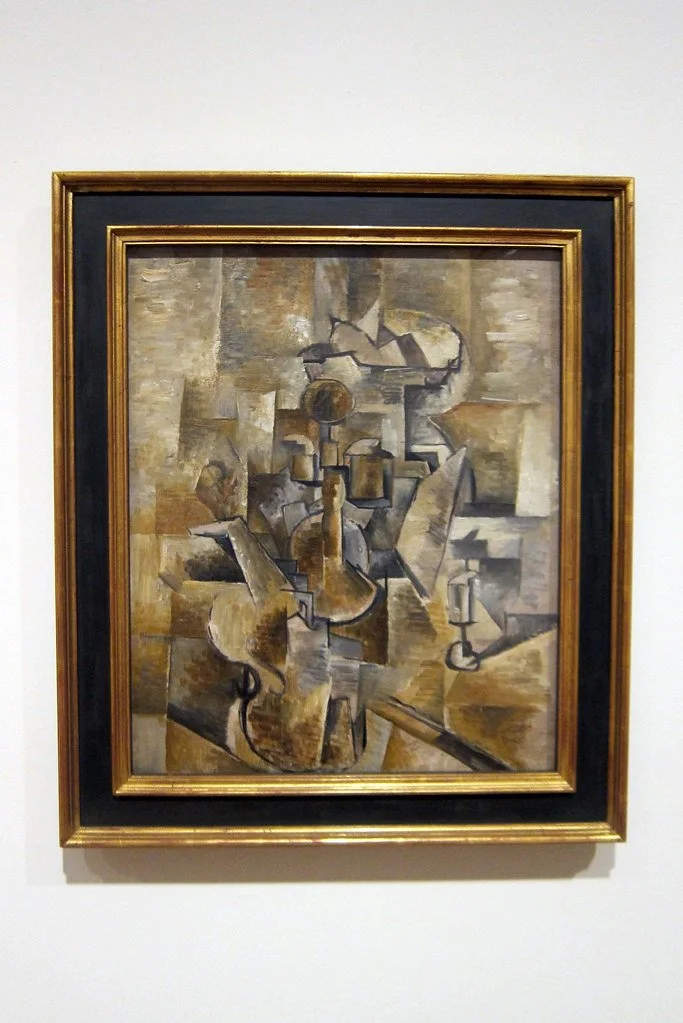
Violin and Candlestick is an early Cubist still life painting composed of fragmented geometric planes and overlapping perspectives. The composition depicts a violin, candlestick, and surrounding tabletop elements broken apart into angular shapes rendered in muted browns, ochres, and grays. Rather than presenting the objects from a single fixed viewpoint, Georges Braque reconstructs them through shifting perspectives and layered spatial relationships, creating a flattened and abstracted interpretation of form characteristic of early Analytical Cubism.
What Makes Contemporary Cubism Different?
While contemporary Cubism draws from the formal innovations of early Cubism, many contemporary artists use fragmentation and abstraction to explore themes that extend beyond formal experimentation alone.
Contemporary Cubist painting often addresses:
identity
technology
surveillance
memory
labor
displacement
environmental anxiety
psychological fragmentation
digital culture
Rather than simply imitating historical Cubist aesthetics, contemporary artists adapt Cubist structures to reflect the complexities of modern life. Fragmentation becomes more than a visual device—it becomes a metaphor for how contemporary individuals experience information, identity, and reality itself.
Fragmentation and Modern Experience
Today, people encounter the world through overlapping systems of media, technology, advertising, social platforms, surveillance, and rapid information exchange. Experiences are often fragmented, nonlinear, and psychologically layered. Contemporary Cubism mirrors these conditions visually.
Multiple perspectives within a single composition can suggest:
conflicting viewpoints
unstable memory
emotional tension
fractured identity
technological mediation
simultaneous realities
This makes Cubism particularly relevant in contemporary society, where perception is increasingly shaped by screens, algorithms, and digital environments.
Contemporary Cubism in Farron Khan’s Work
Colorado artist and contemporary painter Farron Khan incorporates Cubist fragmentation, layered symbolism, and shifting spatial relationships throughout his oil paintings and printmaking work. Influenced by both historical Cubism and contemporary social realities, his paintings explore themes of labor, memory, surveillance, technology, identity, and psychological atmosphere.
Works such as Voyager, Drone Warfare, The Gathering, and Don’t Look Back! You’re Not Going That Way! use fragmented forms and symbolic imagery to examine how individuals navigate uncertainty, systems of power, and collective experience. Rather than treating Cubism as a purely historical style, the work approaches it as an evolving visual language capable of addressing contemporary concerns.
In paintings like The Peach Farmer, Cubist structure becomes a way of emphasizing labor and human endurance, while works such as Eco Pill and Drone Warfare use fragmentation to reflect environmental anxiety and technological tension.
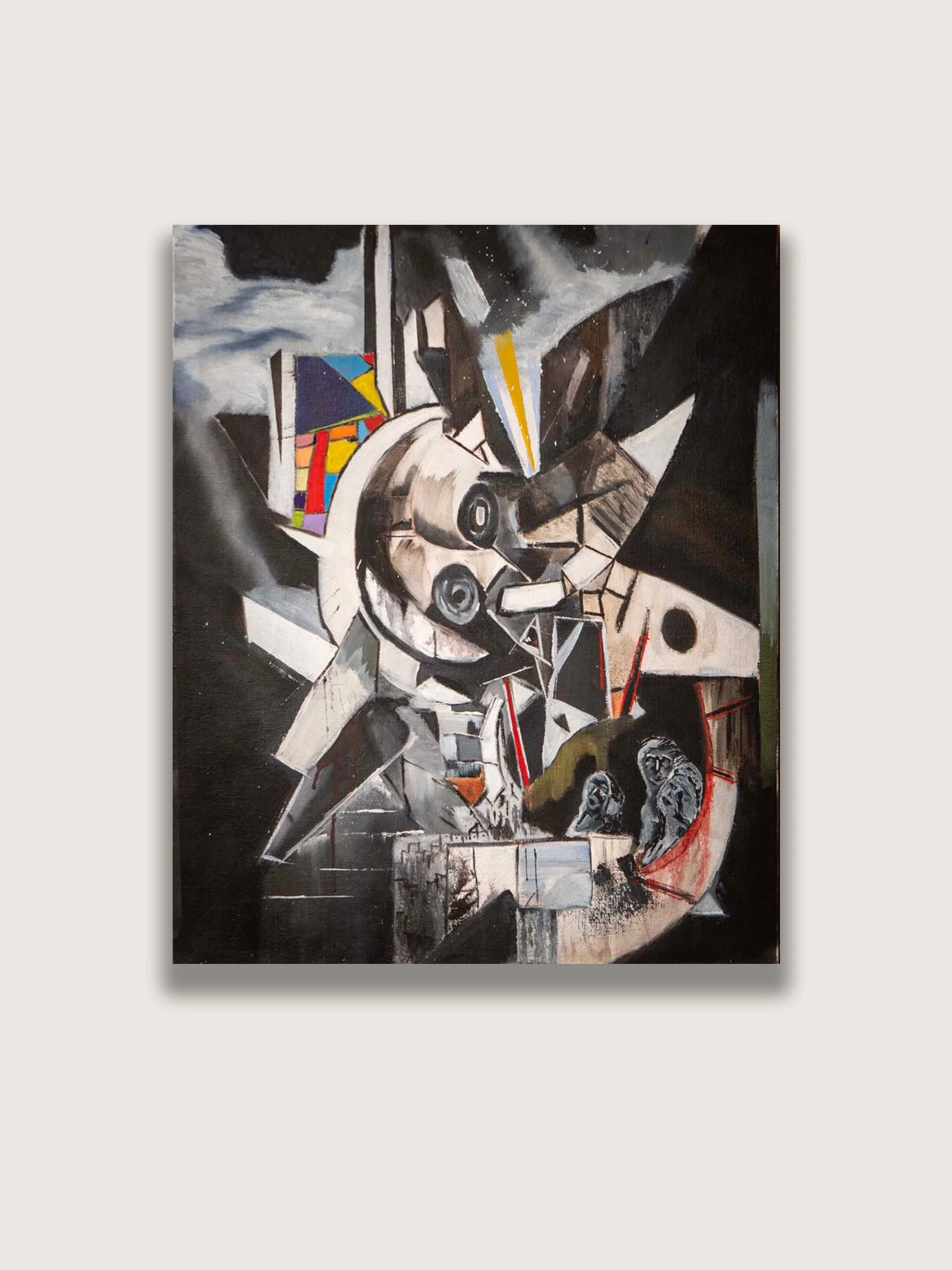
Drone Warfare is a contemporary Cubist oil painting by Farron Khan exploring surveillance, modern conflict, and the psychological distance created by military technology. Through fragmented forms, layered spatial planes, and symbolic mechanical imagery, the composition reflects the tension between human vulnerability and systems of technological control. Angular distortions and overlapping perspectives create an atmosphere of instability and unease, emphasizing themes of observation, power, and the emotional disconnection associated with remote warfare. Influenced in part by Khan’s military background and contemporary geopolitical realities, the painting examines how surveillance technologies increasingly shape both conflict and everyday life.
Why Contemporary Cubism Still Matters
Contemporary Cubism remains relevant because it reflects the instability and complexity of modern life. Its fractured visual structures mirror how people process memory, identity, information, and emotion in an increasingly interconnected world.
By presenting multiple perspectives simultaneously, Cubist-inspired art challenges viewers to slow down, interpret relationships between forms, and engage more actively with what they see. In doing so, contemporary Cubism continues the original movement’s ambition of expanding how reality itself can be represented through art.
Rather than belonging solely to art history, Cubism continues to evolve as artists reinterpret its visual language in response to contemporary culture, technology, and lived experience.
