Fragmentation, Memory, and Perspective in Contemporary Painting
Fragmentation has become one of the most important visual tools in my work because it allows me to move beyond a single fixed perspective. Rather than presenting an image as something stable, complete, or easily resolved, fragmentation gives me a way to explore the layered nature of memory, place, labor, technology, and personal experience. It reflects the reality that the subjects I paint are rarely simple or singular. They exist across multiple emotional, historical, and psychological dimensions at once.
My work is heavily influenced by Cubism, expressionist print traditions, and the visual language of layered imagery. I am interested in how a painting can hold several viewpoints simultaneously and how fragmented forms can create a sense of movement between those viewpoints. Instead of treating fragmentation as destruction or chaos, I approach it as a method of construction. By breaking apart forms and rebuilding them through overlapping planes, repeated shapes, and shifting perspectives, I can create compositions that feel more reflective of lived experience.
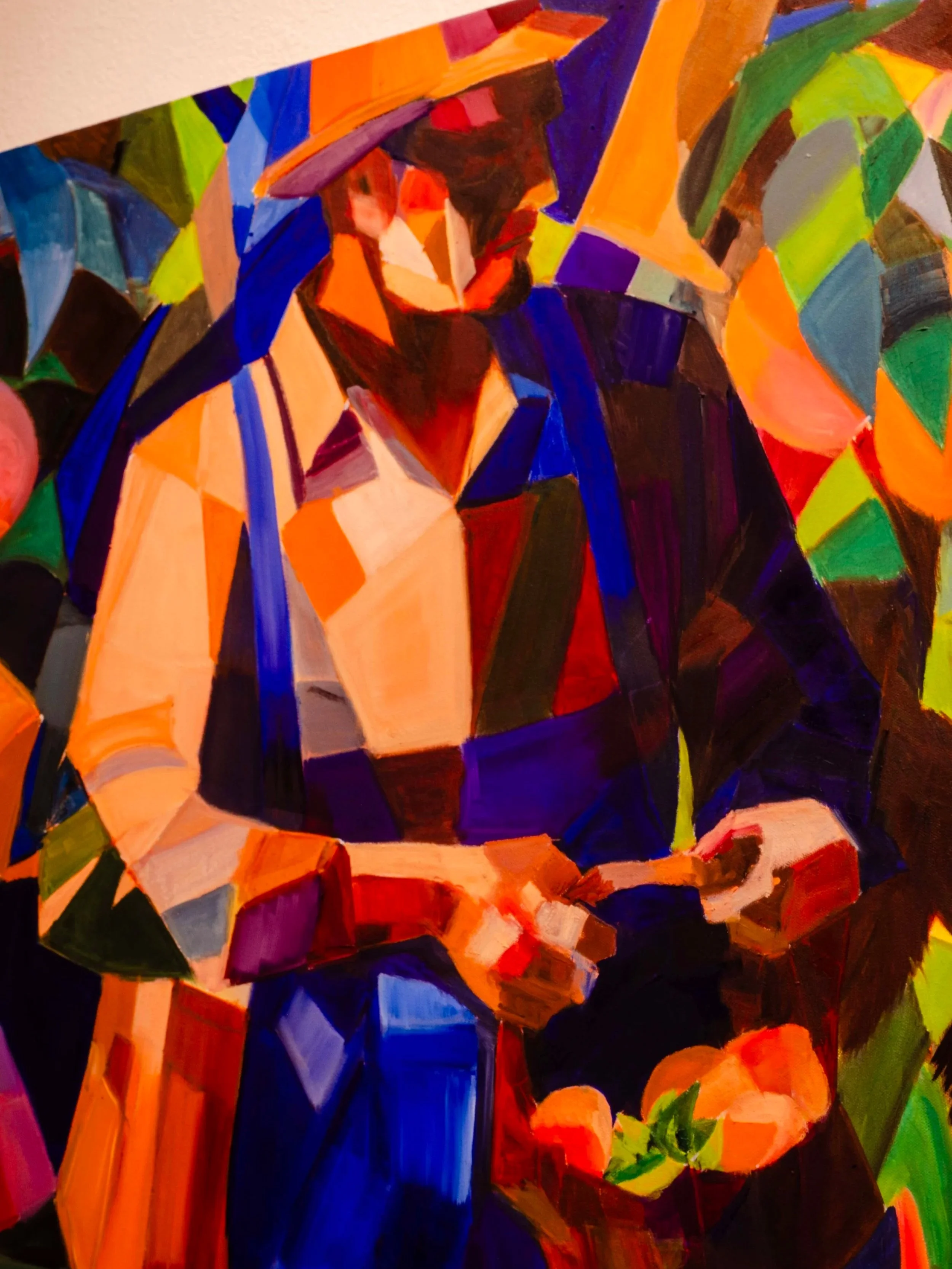
Fragmented geometric planes and saturated color transform an everyday agricultural scene into a layered meditation on labor and identity.
A single image often cannot fully communicate the complexity of a subject. When I paint landscapes, figures, or symbolic objects, I am usually thinking about more than what is immediately visible on the surface. I am thinking about memory, environment, labor, belief systems, technology, and the emotional weight attached to certain places and experiences. Fragmentation allows these ideas to exist together within the same composition.
In many ways, fragmentation mirrors the way memory itself operates. We rarely remember experiences as perfect, uninterrupted images. Instead, memories arrive in pieces — flashes of color, isolated objects, emotional impressions, fragments of conversations, or disconnected environments that become linked together over time. Through fragmentation, I try to recreate that sense of layered recollection. Different sections of a painting can function almost like separate memories or perspectives colliding within the same visual space.
This approach is also important because it helps me address the many sides of the subject matter I am exploring. Many of the themes in my work involve contradiction or tension. A landscape can represent both beauty and hardship. Technology can symbolize both connection and surveillance. Labor can communicate resilience while also pointing toward exhaustion and invisibility. Fragmentation gives me a way to hold those competing ideas together rather than forcing the image into a single interpretation.
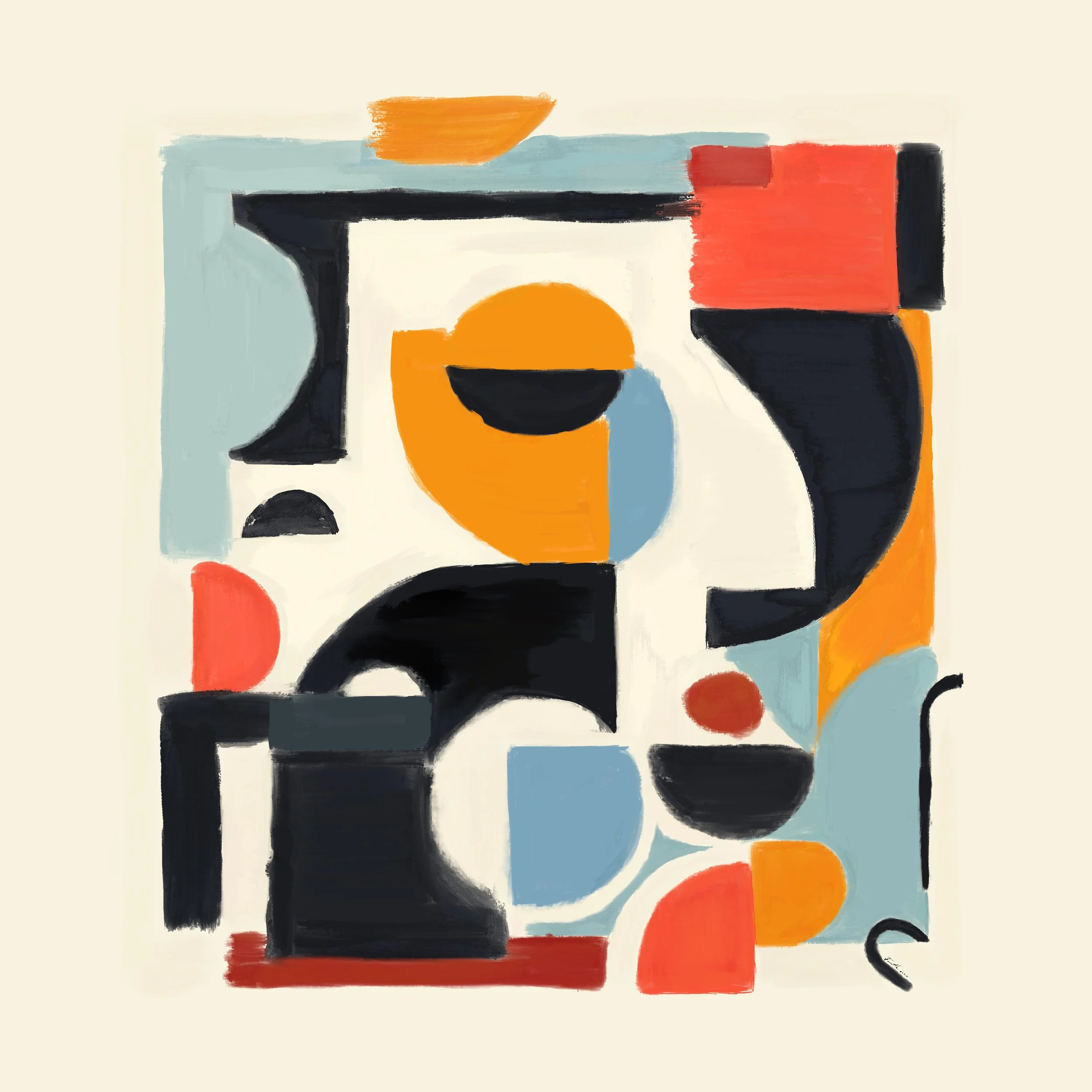
Modular Portrait explores fragmentation through simplified geometric forms and layered spatial relationships. Repeating shapes, cropped curves, and contrasting color fields create a shifting sense of structure, suggesting multiple perspectives existing simultaneously within a unified composition.
I think this is one of the reasons I continue returning to Cubist structures within my paintings and prints. Cubism challenged the idea that an artwork needed to present one stable perspective. Instead, it opened up the possibility that multiple viewpoints could exist simultaneously. That idea still feels incredibly relevant to contemporary life. We constantly experience overlapping realities through memory, media, history, and personal experience. Fragmentation becomes a way of visually acknowledging that complexity.
The physical process of painting fragmented forms is also important to me. Building a composition through layered shapes, directional lines, and shifting planes creates a kind of visual rhythm that guides the viewer across the surface of the painting. I often use changes in color temperature, edge quality, and repetition to create movement between forms. Even when the imagery becomes abstracted, I want the viewer to feel a sense of structure and intentionality beneath the surface.
At the same time, fragmentation allows space for ambiguity. I do not always want the viewer to arrive at a single fixed conclusion about a piece. Instead, I want the work to remain open enough for multiple readings and emotional responses. Fragmented imagery invites the viewer to participate in reconstructing the image and interpreting its meaning. In that sense, the viewer becomes part of the process.
Ultimately, fragmentation is not simply an aesthetic choice in my work. It is a way of thinking about perception, memory, and the complexity of contemporary experience. By breaking apart and reassembling forms, I am trying to create paintings that reflect the layered realities behind the subjects I explore — realities that cannot always be communicated through a single perspective alone.
