How Military Experience Influences My Cubist Paintings and Printmaking
Art rarely emerges in isolation. The experiences we move through, the environments that shape us, and the systems we exist within all leave traces behind. My work is deeply informed by growing up in Western Colorado, serving in the military, and navigating the psychological landscapes that remain long after specific events have passed.
Working primarily in oil painting and linocut printmaking, I use fragmentation, layered imagery, and symbolism to explore how memory, labor, place, and identity intersect. Much of this visual language stems from experiences that resist simple narratives or singular perspectives. Military life, in particular, altered the way I understand structure, perception, and the relationship between individuals and larger systems.
Rather than attempting to document experiences literally, my paintings and prints examine the emotional and psychological residue left behind by them.
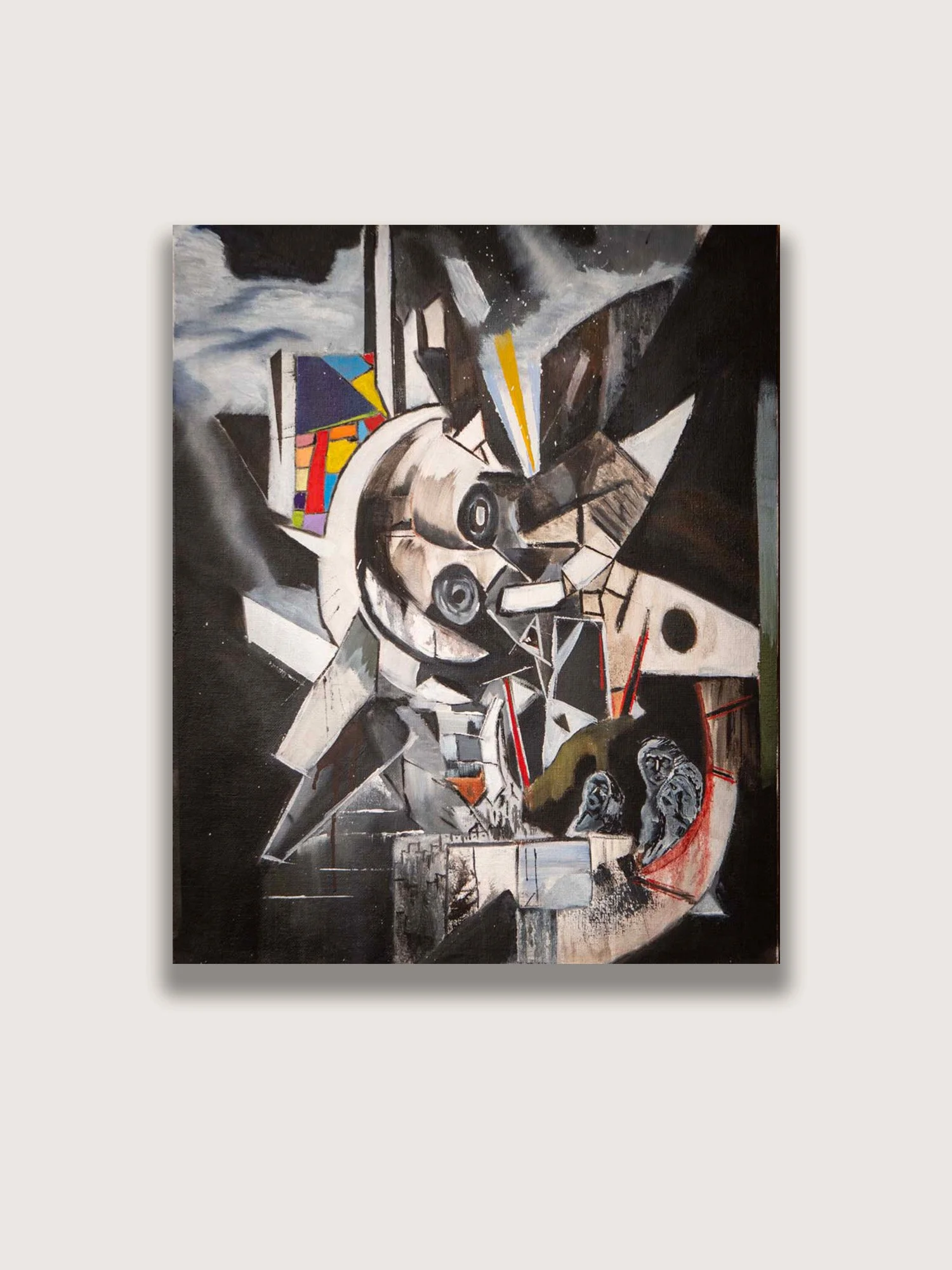
Drone Warfare uses fragmentation and layered Cubist imagery to explore the emotional distance, psychological fragmentation, and abstraction of violence within modern technologically mediated conflict.
Why Fragmentation Appears in My Artwork
Fragmentation became an important visual language in my work because memory itself rarely functions in a linear way. Experiences often return in fragments: images, sensations, environments, or emotions disconnected from a complete narrative. Cubism and related forms of distortion allow me to visually represent that instability while also acknowledging that multiple perspectives can exist simultaneously.
In many of my paintings, figures, spaces, and objects overlap or break apart into shifting planes. This process is not simply stylistic. It reflects the tension between personal memory, collective history, and the ways people construct meaning from incomplete information.
Military environments often emphasize systems, repetition, hierarchy, and collective identity. At the same time, individual experiences within those systems can vary dramatically. Fragmentation allows me to address those contradictions visually rather than resolving them into a single fixed interpretation.
I am interested in how people carry experiences long after they leave particular environments, and how those experiences continue shaping perception over time.
Landscape as Psychological Space
Growing up in Western Colorado also plays an important role in my work. Landscapes are never neutral to me. Places accumulate emotional weight through memory and association. A hometown can feel comforting while simultaneously holding tension, contradiction, or unresolved history.
Similarly, military spaces often become psychologically charged environments. Barracks, training grounds, deserts, industrial structures, and temporary architecture all carry a particular emotional atmosphere. Even after leaving those places, aspects of them remain embedded in memory.
My paintings frequently blur distinctions between interior and exterior spaces, physical environments and psychological states. I am less interested in creating direct representations of locations than I am in exploring how environments shape emotional experience.
Labor, Systems, and Overlooked People
Another recurring focus in my work is labor and the people whose work quietly sustains daily life. I am drawn to individuals and communities that are frequently overlooked despite playing essential roles within larger systems.
Military life reinforced my awareness of institutional structures and the ways individuals are often absorbed into broader mechanisms of organization, production, and power. That awareness extends beyond military experience and informs how I think about labor, technology, infrastructure, and social systems more broadly.
Many of my paintings and prints examine how people navigate these systems while attempting to preserve individuality, dignity, and meaning. Through layering, distortion, and repetition, I try to create images that feel simultaneously human and structural.
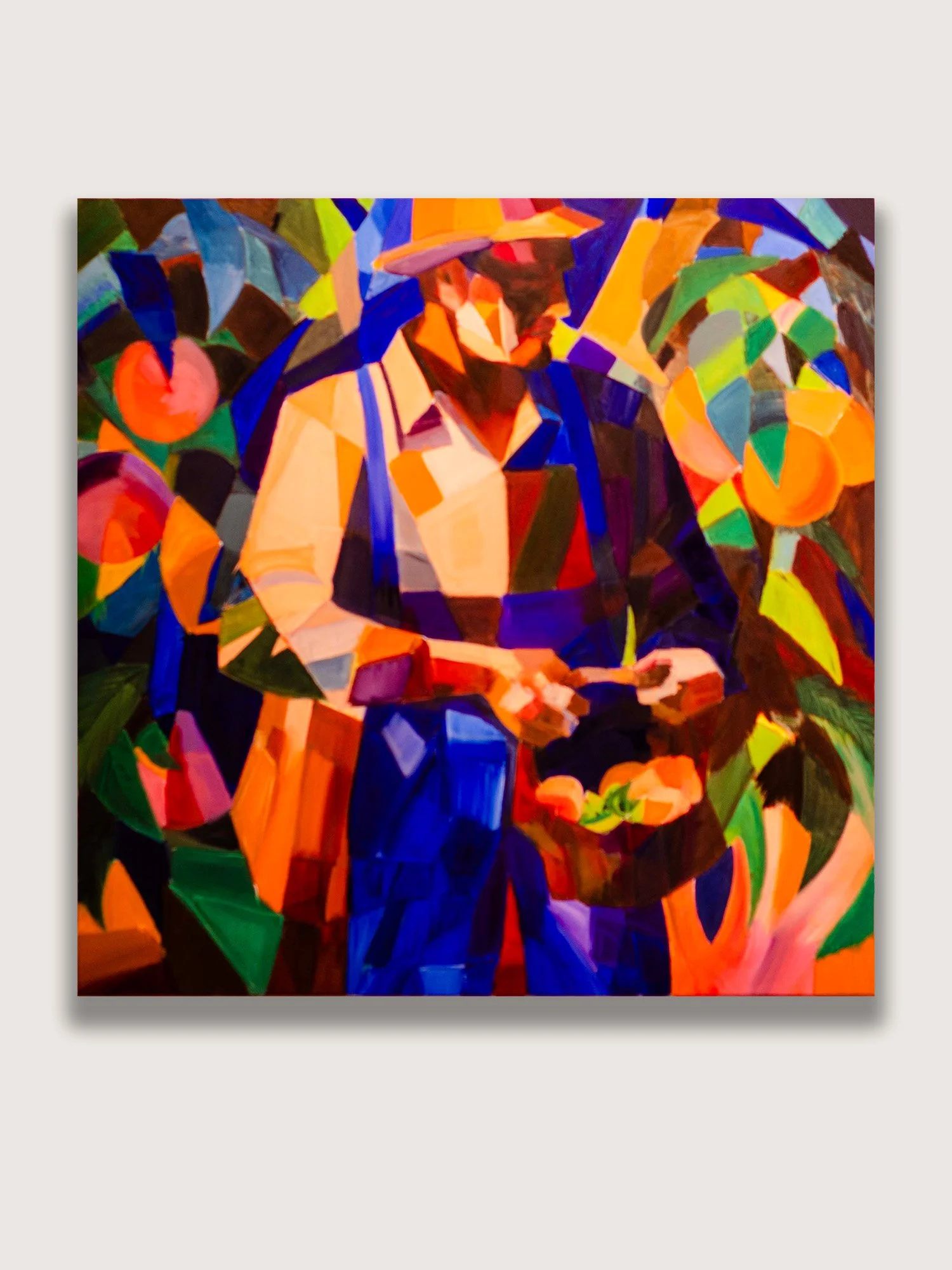
Peach Farmer uses Cubist fragmentation and layered perspectives to explore labor, identity, and the enduring relationship between agricultural workers and the landscapes that shape their lives in Western Colorado.
Why I Continue Working in Oil Painting and Printmaking
Oil painting and linocut printmaking both allow for a slow and deliberate process of construction. I am drawn to mediums that leave visible evidence of labor, revision, and accumulation over time.
Printmaking especially appeals to me because carving into a surface requires commitment and physical engagement. Every mark becomes part of the final image. Painting, meanwhile, allows for layering, revision, and the gradual building of relationships between color, texture, and form.
Both mediums support the themes I am interested in exploring: memory, endurance, fragmentation, and reconstruction.
Art as Reconstruction Rather Than Resolution
I do not view art as a way of simplifying experience into clear answers. Instead, I think of painting and printmaking as spaces where complexity can remain visible. Experiences related to memory, military service, place, and identity rarely resolve cleanly, and I am more interested in preserving ambiguity than forcing closure.
My work invites viewers to navigate layered images in much the same way people navigate memory itself: partially, emotionally, and from multiple perspectives at once.
Ultimately, the goal is not to recreate specific events, but to create visual spaces where viewers can reflect on labor, history, place, and the systems that quietly shape everyday life.
Farron Khan is a Western Colorado artist working in oil painting and linocut printmaking. His work explores fragmentation, labor, memory, and psychological landscapes.
