 Image 1 of 1
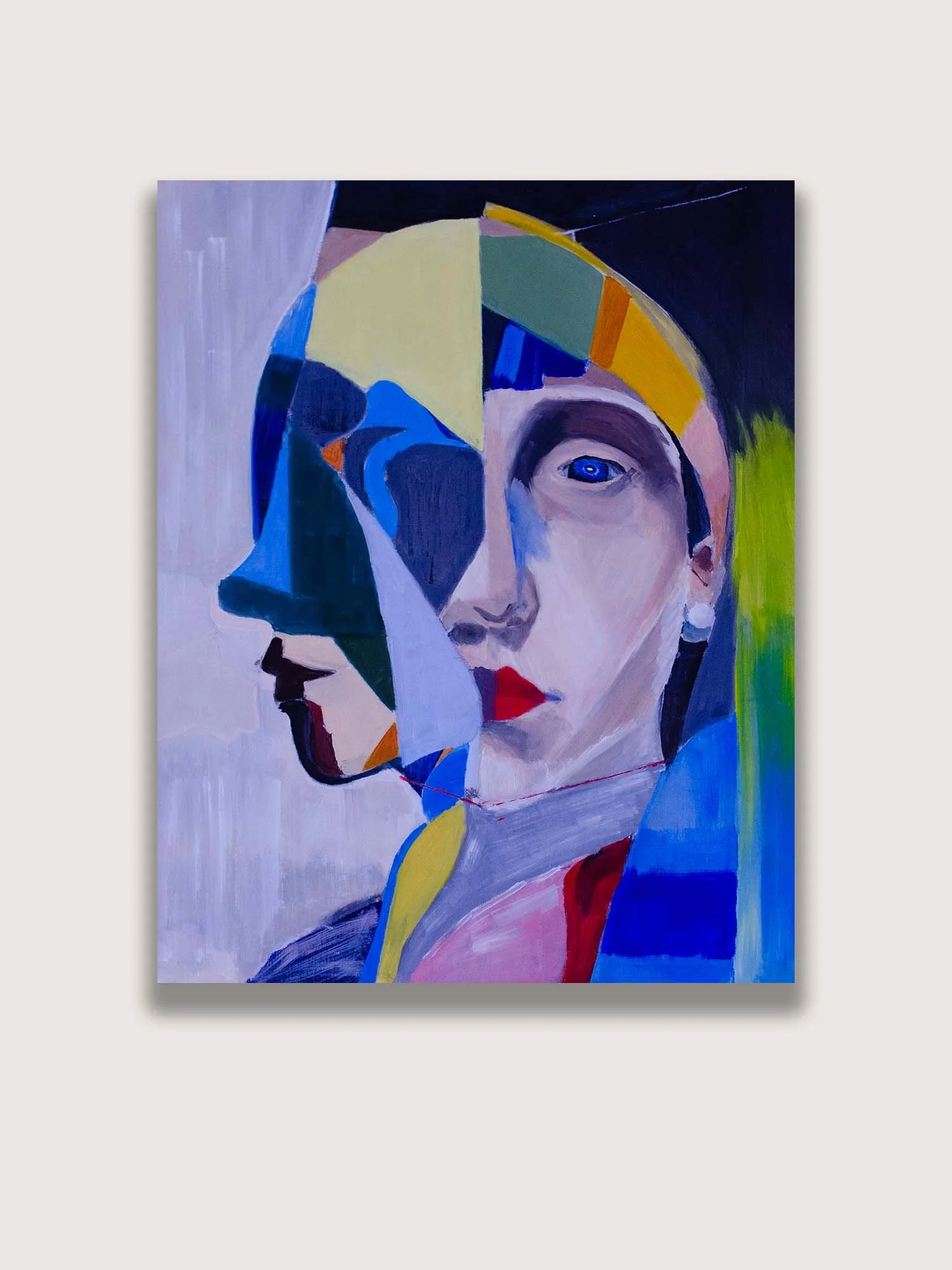
This painting reinterprets Girl with a Pearl Earring by Johannes Vermeer through a Cubist lens, breaking the familiar image into fractured planes of color and shifting perspective. The composition divides the figure into dual visual languages: one side retains a sense of recognizable form, while the other dissolves into angular abstraction, emphasizing structure over illusion. Bold passages of blue, yellow, and green contrast with muted flesh tones, creating a dynamic interplay between clarity and fragmentation.
At the center, the subject’s gaze remains steady, anchoring the composition despite its disruption. The iconic pearl earring persists as a point of continuity, connecting this contemporary study to its historical source. By reconstructing the figure through layered geometric forms, the painting explores how perception is not fixed, but assembled—piece by piece—through memory, influence, and reinterpretation.
Balancing homage with transformation, this work engages directly with art history while asserting its own visual language. It invites the viewer to reconsider a familiar image, not as a static icon, but as something fluid—capable of being seen, broken apart, and reimagined anew.
This painting reinterprets Girl with a Pearl Earring by Johannes Vermeer through a Cubist lens, breaking the familiar image into fractured planes of color and shifting perspective. The composition divides the figure into dual visual languages: one side retains a sense of recognizable form, while the other dissolves into angular abstraction, emphasizing structure over illusion. Bold passages of blue, yellow, and green contrast with muted flesh tones, creating a dynamic interplay between clarity and fragmentation.
At the center, the subject’s gaze remains steady, anchoring the composition despite its disruption. The iconic pearl earring persists as a point of continuity, connecting this contemporary study to its historical source. By reconstructing the figure through layered geometric forms, the painting explores how perception is not fixed, but assembled—piece by piece—through memory, influence, and reinterpretation.
Balancing homage with transformation, this work engages directly with art history while asserting its own visual language. It invites the viewer to reconsider a familiar image, not as a static icon, but as something fluid—capable of being seen, broken apart, and reimagined anew.